
Learner-centered education begins with a simple but radical belief: every learner is capable, curious, and worthy of an education that honors who they are and who they can become. It is an approach rooted in relationships, relevance, and agency – where deep, meaningful learning grows from each learner’s strengths, interests, and context, rather than a prescribed curriculum or a test.
In 1894, the National Education Association’s Committee of Ten proposed a model that still defines the structure of school today: twelve years, core academic subjects, and “seat time” as the measure of learning. This industrial design prioritized uniformity and college preparation over purpose, real-world learning, and personalization. While it served an era focused on sorting students into the workforce or higher education, it no longer reflects the world learners inhabit today. It is incumbent on us to shift our education model from a school-centered hierarchy to a learner-centered ecosystem.
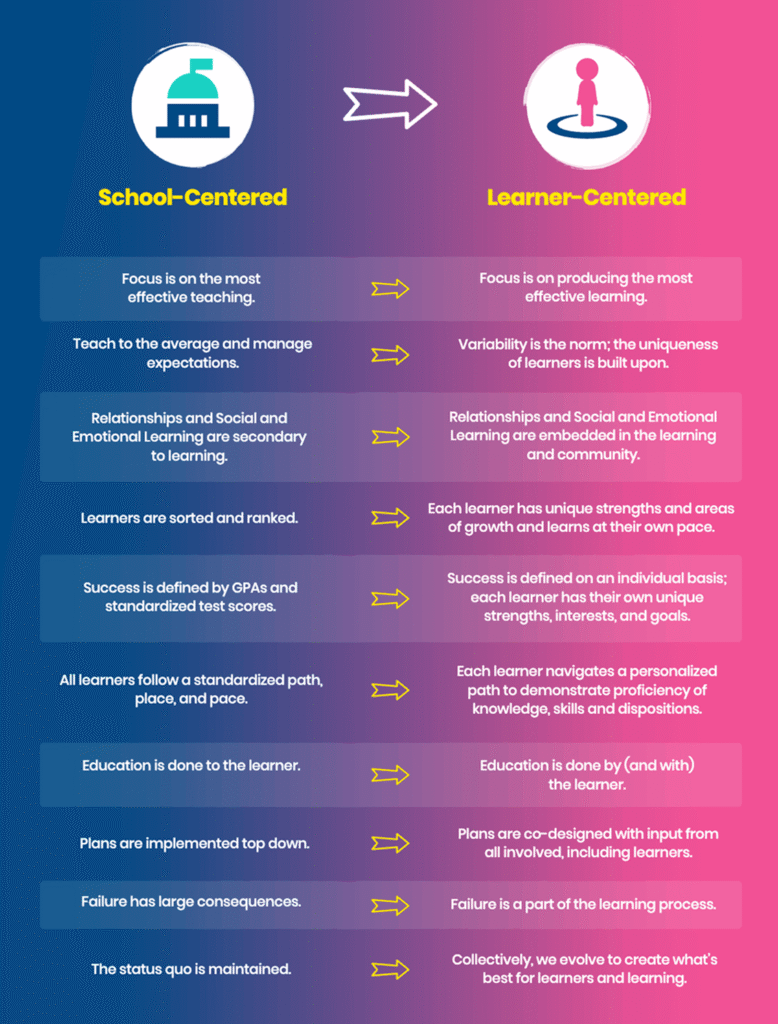
A Learner-Centered Ecosystem by Dr. Katie Martin
Instead of asking how students can fit into the system, a learner-centered paradigm asks us to consider how the system can fit each learner. In practice, learner-centered education recognizes students as active partners in their learning rather than passive recipients. This approach equips learners not only with foundational knowledge but also with the essential competencies – such as collaboration, creativity, and critical thinking—that enable success beyond school.
Why It Matters Now More Than Ever
The urgency for a learner-centered ecosystem has never been greater. Across the country, districts face declining enrollment, disengagement, stagnant outcomes, and eroding trust in public education. Students and families are signaling that the traditional, one-size-fits-all model no longer meets their needs or aspirations.
At the same time, rapid technological change – especially the rise of artificial intelligence – is reshaping how we live, learn, and work. Information is no longer scarce; it is everywhere. What matters now is not how much we can memorize, but how we apply foundational skills to think critically, solve problems, and adapt with empathy and integrity. These human capacities develop best through learning experiences that prioritize connection, curiosity, and agency.
If we overlay artificial intelligence on a traditional, school-centered model, education risks becoming even more standardized and impersonal. Learner-centered ecosystems, by contrast, ensure technology amplifies human potential rather than replaces it.
Early evidence from our research partners demonstrates the impact of learner-centered ecosystems:
- Higher student engagement and sense of belonging
- Growth in reading, math, and whole-learner outcomes
- Increased confidence and readiness for college, career, and life
When learners feel ownership and purpose, academic achievement and well-being rise together. Learner-centered education isn’t just more humane – it’s more effective.
How We Get There: Transforming Systems from Within
The shift to learner-centered education isn’t about adding new programs or technology; it’s about shifting mindsets, practices, structures, and culture. It requires reimagining how change happens inside systems; not from top-down mandates but from a co-design and decision-making process that ensures the entire learning community is represented.
At Learner-Centered Collaborative, we’ve learned that sustainable transformation happens when communities co-create their future. A powerful example comes from Escondido Union School District (EUSD). Guided by Superintendent Dr. Luis Ibarra, the district engaged teachers, staff, parents, and students to design a new vision to “actualize the unlimited potential of every learner.”
Working together, EUSD and Learner-Centered Collaborative facilitated student forums, convened design teams, and co-created a Framework for the Future. This framework defines success for every learner, maps big moves across the system, and outlines a personalized, authentic, and competency-based learning model. School teams have engaged in school redesign, reimagining learning experiences, and leadership academies that inspire and support learner-centered innovation. As Deputy Superintendent Laura Philyaw explained, “Times have changed and the needs of our students have changed – and so we have to change, too.” Their example illustrates a crucial truth: meaningful transformation happens with communities, not to them.
Creating Sustainable, Learner-Centered Evolution from Within
Transforming public education into a truly learner-centered ecosystem requires more than new programs or policies—it demands a fundamental shift in how change itself happens. Lasting transformation occurs when districts become the engines of their own research and development: building urgency for change, supporting people through transition, and empowering educators, students, and families to co-create the future together. Rather than relying on top-down mandates, this approach cultivates a clear vision and a culture of intentional innovation, reflection, and shared ownership, allowing new mindsets, practices, and systems to take root and flourish.
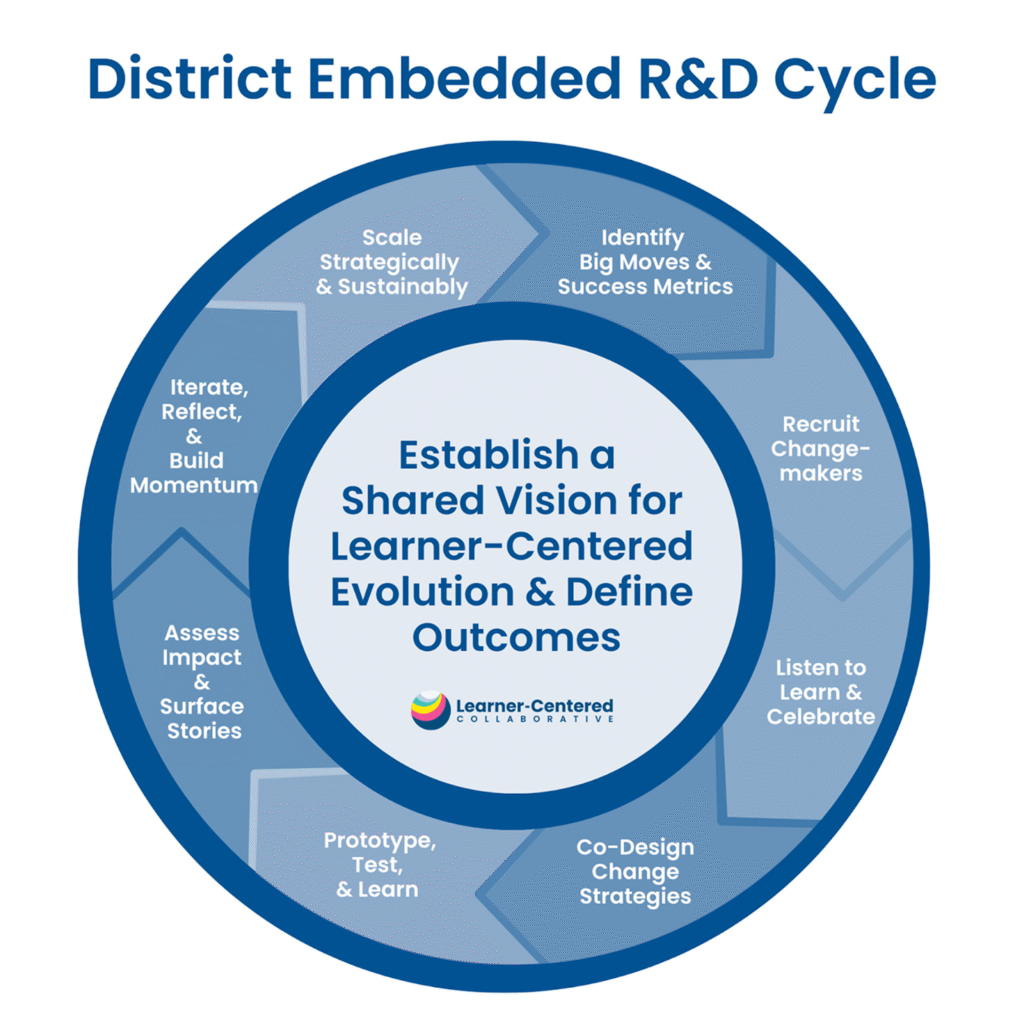
At the heart of this work is the recognition that change is both human and systemic. The learner-centered change process draws on research from education, psychology, organizational change, and design – all converging around the shared goal of creating systems that honor how people learn, grow, and thrive.
To guide this work, we draw on key insights from change management frameworks. Bridges’ Transition Model highlights the emotional journey of change – helping people let go of the old, navigate uncertainty, and embrace new beginnings. Kotter’s Dual Operating System underscores the need for both structure and agility, where formal systems and networked teams operate in tandem. And Rogers’ Diffusion of Innovation reminds us that engaging early adopters and innovators accelerates momentum, builds trust, and creates the conditions for scale and sustainability.
The process of redesigning systems, grounded in principles of Improvement Science and Design Thinking, ensures that the change process is both data-informed and deeply human. Over time, districts evolve into dynamic ecosystems of learning – where educators, students, and families co-create and refine practices together.
Sustaining this evolution requires job-embedded professional learning that supports educators through coaching, collaboration, and continuous feedback within daily practice. Research-practice partnerships can then connect local innovation to broader systems change, ensuring both rigor and relevance.
Together, these insights affirm that transformation is not a one-time initiative but a living process – one that balances vision with humanity, and structure with creativity.
The Future We’re Building
A learner-centered ecosystem doesn’t just prepare young people for the future; it builds the very qualities humanity will need to shape it.
We already see this future emerging in classrooms that replace worksheets with real-world challenges, in districts shifting from grading to growth, and in educators using AI to deepen, not diminish, human connection. The task before us is not to imagine whether such a system is possible, but to act together to make it inevitable.